 visiora
Do heavier objects fall faster? Galileo's free-fall idea, explained
A bowling ball and a basketball dropped from 30 m land almost together. Here is why mass doesn't decide how fast things fall, and when air changes the answer.
Ask ten people whether a heavy bowling ball falls faster than a light basketball, and most will say yes. It feels obvious: heavy things are pulled down harder, so they should win the race.
For almost 2,000 years, that was also the official answer. Aristotle taught that heavier objects fall faster in proportion to their weight. Then, around 1590, Galileo Galilei tested it and found something surprising.
What Galileo found
Galileo showed that, if you ignore air, every object falls with the same acceleration, no matter its mass. A 7 kg bowling ball and a 0.6 kg basketball, released together, hit the ground together.
The story says he dropped balls from the Leaning Tower of Pisa. Historians aren't sure that happened, but his experiments with balls rolling down slopes, and his reasoning, settled the question.
Why mass doesn't matter
Gravity does pull harder on the heavier ball. The bowling ball's weight is more than ten times the basketball's.
But a heavier object is also harder to speed up. That resistance to changing motion is its mass, its inertia. Newton's second law puts the two together:
acceleration = force ÷ mass
The force (weight) is m × g, so the acceleration is (m × g) ÷ m = g. The mass cancels out. Every object near Earth's surface speeds up by the same amount every second: g = 9.8 m/s².
How long does a 30 m fall take?
With no air, the time to fall a height h is:
t = √(2h ÷ g)
For a 30 m drop on Earth: t = √(2 × 30 ÷ 9.8) ≈ 2.47 seconds, for a feather, a coin or a bowling ball alike.
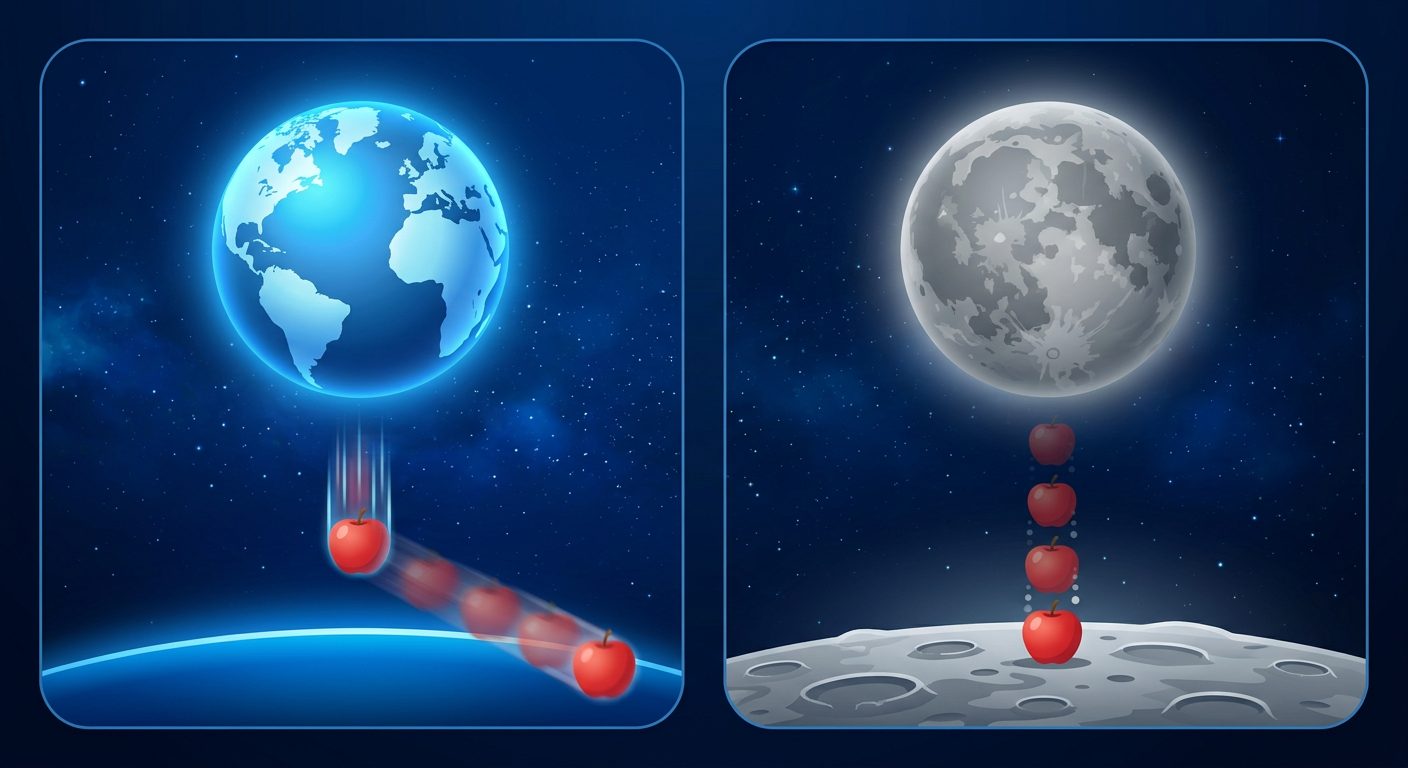
On the Moon, where g is only 1.62 m/s², the same drop takes about 6.1 seconds. On Jupiter (g ≈ 24.8 m/s²) it takes just 1.6 seconds.
So why does a feather fall slowly?
Because Earth has air. As an object falls, air pushes back on it, and that push grows with speed. What matters is how big that push is compared with the object's weight.
- A bowling ball is heavy for its size. Air barely slows it.
- A basketball is light for its size. Air slows it a little more.
- A feather or a balloon is extremely light for its size. Air slows it a lot.
Dropped from 30 m with real air resistance, the numbers look like this:
| Object | Mass | Time to fall 30 m | No-air time |
|---|---|---|---|
| Bowling ball | 7 kg | 2.49 s | 2.47 s |
| Basketball | 0.62 kg | 2.74 s | 2.47 s |
The bowling ball wins, but only by a quarter of a second, and it wins because of air, not because gravity favours heavy things. Take the air away and they tie.
The Apollo 15 astronauts proved this on the Moon in 1971: a hammer and a falcon feather, dropped together in a vacuum, landed at the same moment.
Terminal speed: why things stop speeding up
With air, a falling object can't keep speeding up forever. Eventually the air's push equals the weight, the forces balance, and the speed stops growing. That top speed is the terminal speed.
A basketball's terminal speed is about 22 m/s. A bowling ball's is about 80 m/s, so in a short 30 m drop it never gets close. That gap is exactly why the bowling ball pulls ahead.
Key points to remember
- Without air, all objects fall with the same acceleration, g ≈ 9.8 m/s² on Earth.
- Mass cancels out: heavier objects are pulled harder but are also harder to speed up.
- Fall time from height h (no air) is √(2h ÷ g).
- Air resistance is why light, large objects fall slowly. It's the air, not their mass.
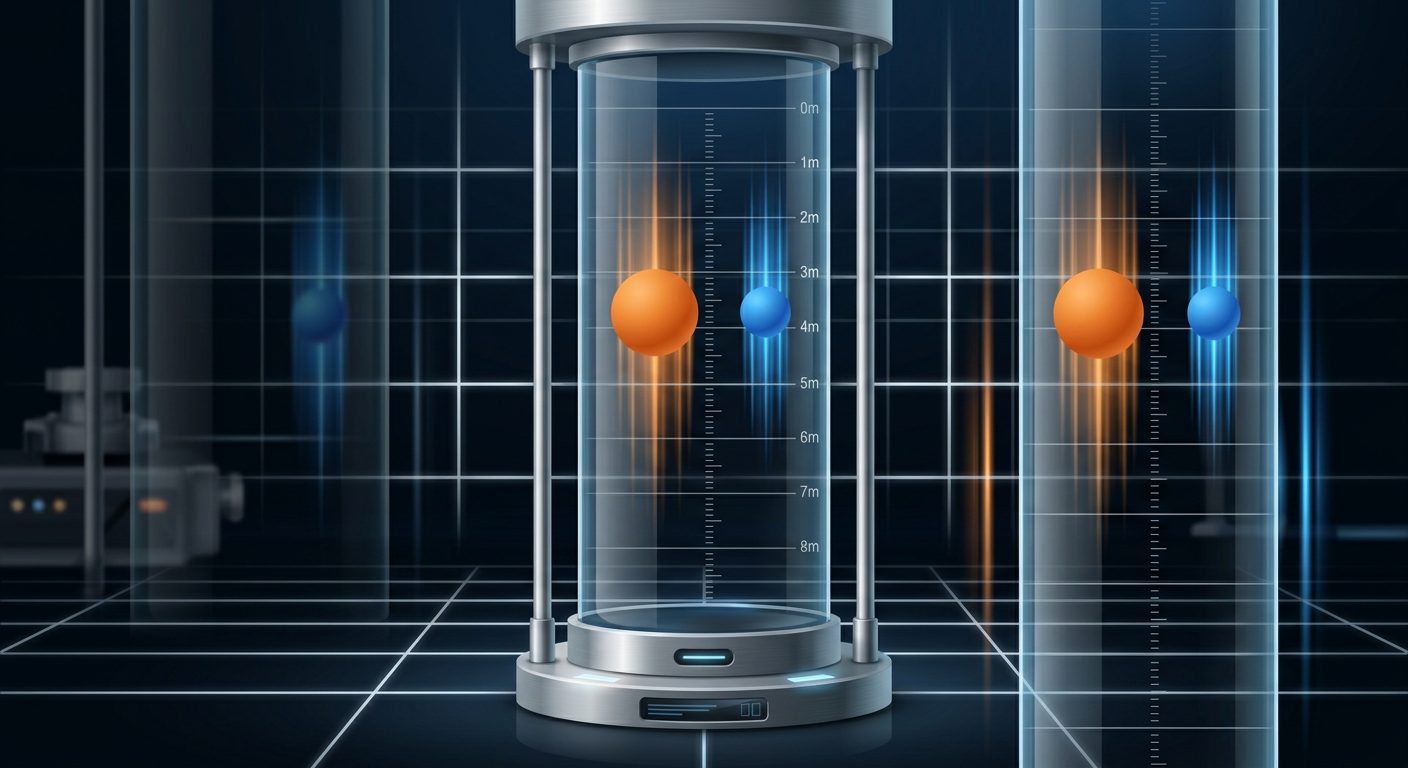
The best way to really believe this is to see it. Drop a bowling ball and a basketball side by side, switch the air off, and watch them land together.
Keep reading

Difference Between Speed and Velocity: Class 9 Physics
Master the difference between speed and velocity for CBSE Class 8–10. Includes comparison tables, formulas, real-world examples, and solved problems.
Gravity on the Moon: Value, Formula & Lab (Class 9)
Learn the value of acceleration due to gravity on the Moon, derive the formula, and explore fun virtual labs. Perfect for CBSE & NCERT Class 9 physics!
What is Free Fall Class 9? Notes, Formula & Examples
Learn what free fall is in Class 9 Physics (NCERT). Explore the definition, acceleration due to gravity (g), formulas, solved numericals, and quick labs.