 visiora
Gravity on the Moon: Value, Formula & Lab (Class 9)
Learn the value of acceleration due to gravity on the Moon, derive the formula, and explore fun virtual labs. Perfect for CBSE & NCERT Class 9 physics!
Introduction to Acceleration Due to Gravity
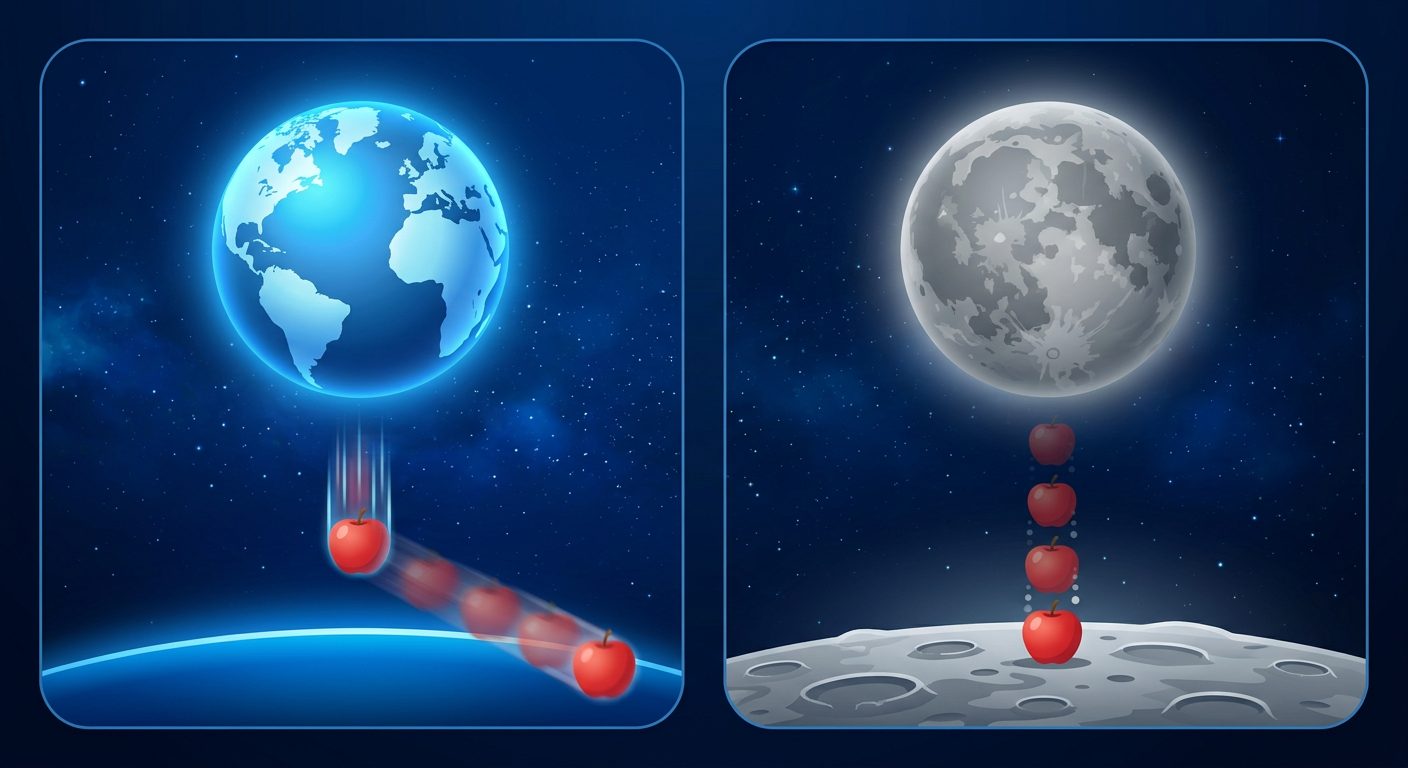
Have you ever watched videos of astronauts hopping across the lunar surface? Instead of walking normally, they bound effortlessly, floating through the air with every stride. This dreamlike motion happens because the acceleration due to gravity on the moon is vastly weaker than what we experience on Earth.
To understand why this happens, we first need to explore what gravitational acceleration actually means, how celestial bodies exert pull on objects, and how your weight changes when you leave our home planet.
What Does g Really Mean?
Whenever you drop an object from a height, it accelerates downward toward the ground. If you ignore air resistance, every falling object speeds up at a steady, uniform rate. This state is known as free fall, and the steady acceleration experienced by any freely falling body is called the acceleration due to gravity, denoted by the small letter g.
On Earth, the standard average value of g near the surface is 9.8 m/s². This means that every single second an object falls freely on Earth, its downward speed increases by 9.8 meters per second. But gravity is not a universal constant everywhere you stand; it depends on the mass and size of the celestial body beneath your feet.
Mass vs. Weight: Clearing the Common Confusion
In everyday conversation, people often use "mass" and "weight" interchangeably. However, in physics—and specifically in NCERT Class 9 Science — Gravitation—they represent two very different physical quantities:
- Mass (m): The measure of the amount of matter contained inside an object. It is a scalar quantity measured in kilograms (kg). Your mass is constant and remains identical whether you are sitting in your classroom, floating in deep space, or walking on the Moon.
- Weight (W): The gravitational force with which a celestial body pulls an object toward its center. Because weight is a force, it is a vector quantity measured in Newtons (N). Weight depends directly on the local gravitational acceleration: W = m × g.
Because your mass never changes, any change in your weight across different planets comes purely from the difference in local gravitational pull. This brings us to a key question: how strong is gravity on our nearest cosmic neighbor?
What is the Value of g on the Moon?
If you step onto a bathroom scale on the Moon, the number you see drops dramatically. But what is the exact value of g on moon?
Numerical Value and Units
The precise average value of acceleration due to gravity on the Moon's surface is:
gm = 1.62 m/s² (often approximated as 1.63 m/s² in NCERT textbook exercises).
Just like on Earth, the SI unit is meters per second squared (m/s²), or Newtons per kilogram (N/kg). This means that a falling object on the Moon gains only 1.62 m/s of speed every second—roughly six times slower than an object falling on Earth!
The "1/6th" Earth Rule: Gravity on Moon vs Earth
When comparing gravity on moon vs earth, physicists and students use a handy rule of thumb: lunar gravity is approximately one-sixth of terrestrial gravity.
Let us check the ratio:
gm / ge = 1.62 m/s² / 9.8 m/s² ≈ 0.165 ≈ 1/6
Because weight is given by W = m × g, your weight on the Moon is also one-sixth of your weight on Earth:
Wmoon = (1/6) × Wearth
If a person weighs 600 N on Earth, their weight on the Moon is merely 100 N. They feel remarkably light, allowing them to jump higher and carry bulky spacesuits with surprising ease.
Step-by-Step Derivation of Acceleration Due to Gravity on the Moon
How do scientists determine this value without measuring every square meter of the lunar surface? In your school examinations, you will often be asked how to calculate acceleration due to gravity on moon using Newton's Universal Law of Gravitation. Let us break down the derivation step by step.
The Acceleration Due to Gravity Formula NCERT
According to Newton's Universal Law of Gravitation, the gravitational force (F) between a planet of mass M and an object of mass m resting on its surface with radius R is:
F = G × M × m / R²
From Newton's second law of motion, the force acting on the object is also equal to mass times acceleration:
F = m × g
Equating both expressions for force:
m × g = G × M × m / R²
Canceling the mass of the object (m) from both sides gives the standard acceleration due to gravity formula ncert:
g = G × M / R²
Notice a crucial physical fact: the acceleration due to gravity depends only on the Universal Gravitational Constant (G), the mass of the planet (M), and the radius of the planet (R). It does not depend on the mass of the falling object at all!
Moon's Astronomical Data
To calculate g on the Moon (gm), we substitute the known astronomical measurements of the Moon into the formula:
- Universal Gravitational Constant (G): 6.67 × 10⁻¹¹ N·m²/kg²
- Mass of the Moon (Mm): 7.36 × 10²² kg
- Radius of the Moon (Rm): 1.74 × 10⁶ m (or 1,740 km)
Calculation Walkthrough
Now, let us substitute these values into our formula:
gm = (G × Mm) / (Rm)²
gm = [6.67 × 10⁻¹¹ × 7.36 × 10²²] / (1.74 × 10⁶)²
Let us solve this in two parts—the numbers and the powers of ten:
1. Multiply the numerators: 6.67 × 7.36 ≈ 49.09
2. Combine powers of ten in numerator: 10⁻¹¹ × 10²² = 10¹¹
3. Square the denominator: (1.74)² × (10⁶)² ≈ 3.0276 × 10¹²
Now, divide the numerator by the denominator:
gm = (49.09 × 10¹¹) / (3.0276 × 10¹²)
gm = (49.09 / 3.0276) × 10⁻¹
gm = 16.21 × 10⁻¹ ≈ 1.62 m/s²
This yields the textbook value of 1.62 m/s².
Deriving the Ratio: Wmoon = (1/6) Wearth
In CBSE board examinations, a frequent question asks you to prove that the weight of an object on the moon class 9 is one-sixth of its weight on Earth using ratio comparison. Here is the formal exam method:
Let mass of Earth be Me = 5.98 × 10²⁴ kg and radius of Earth be Re = 6.37 × 10⁶ m.
Let mass of Moon be Mm = 7.36 × 10²² kg and radius of Moon be Rm = 1.74 × 10⁶ m.
The weight on Moon is Wm = G × Mm × m / Rm²
The weight on Earth is We = G × Me × m / Re²
Dividing Wm by We:
Wm / We = (Mm / Me) × (Re / Rm)²
Substitute the values:
Wm / We = [(7.36 × 10²² kg) / (5.98 × 10²⁴ kg)] × [(6.37 × 10⁶ m) / (1.74 × 10⁶ m)]²
Wm / We = (0.0123) × (3.66)²
Wm / We = 0.0123 × 13.40 ≈ 0.165 ≈ 1/6
Therefore, Wmoon = (1/6) × Wearth. This neat relationship confirms that any object weighed on the Moon registers approximately one-sixth of its Earth weight.
Interactive Lab: Free Fall on the Moon vs. Earth
How does this lower gravitational pull change everyday motion? The best way to understand the physics of gravity is to see it in action.
The Hammer and Feather Drop Moon Experiment
Back in 1589, Galileo famously reasoned that in the absence of air resistance, all objects fall at the exact same rate regardless of their mass. If you have ever wondered whether heavier objects fall faster, the answer is a firm no—air drag is the only reason a feather drifts down slowly on Earth while a stone plummets.
In 1971, during the Apollo 15 mission, an astronaut performed the ultimate demonstration directly on the lunar surface. Holding a heavy 1.32 kg geological hammer in one hand and a light 0.03 kg falcon feather in the other, he released them simultaneously from a height of about 1.6 meters. Because the Moon has virtually no atmosphere to generate air resistance, both objects hit the lunar dirt at the exact same instant!
This legendary hammer and feather drop moon experiment provided stunning visual confirmation of Galileo's insight and Newton's gravitational formula.
Try It in the Visiora Interactive Lab
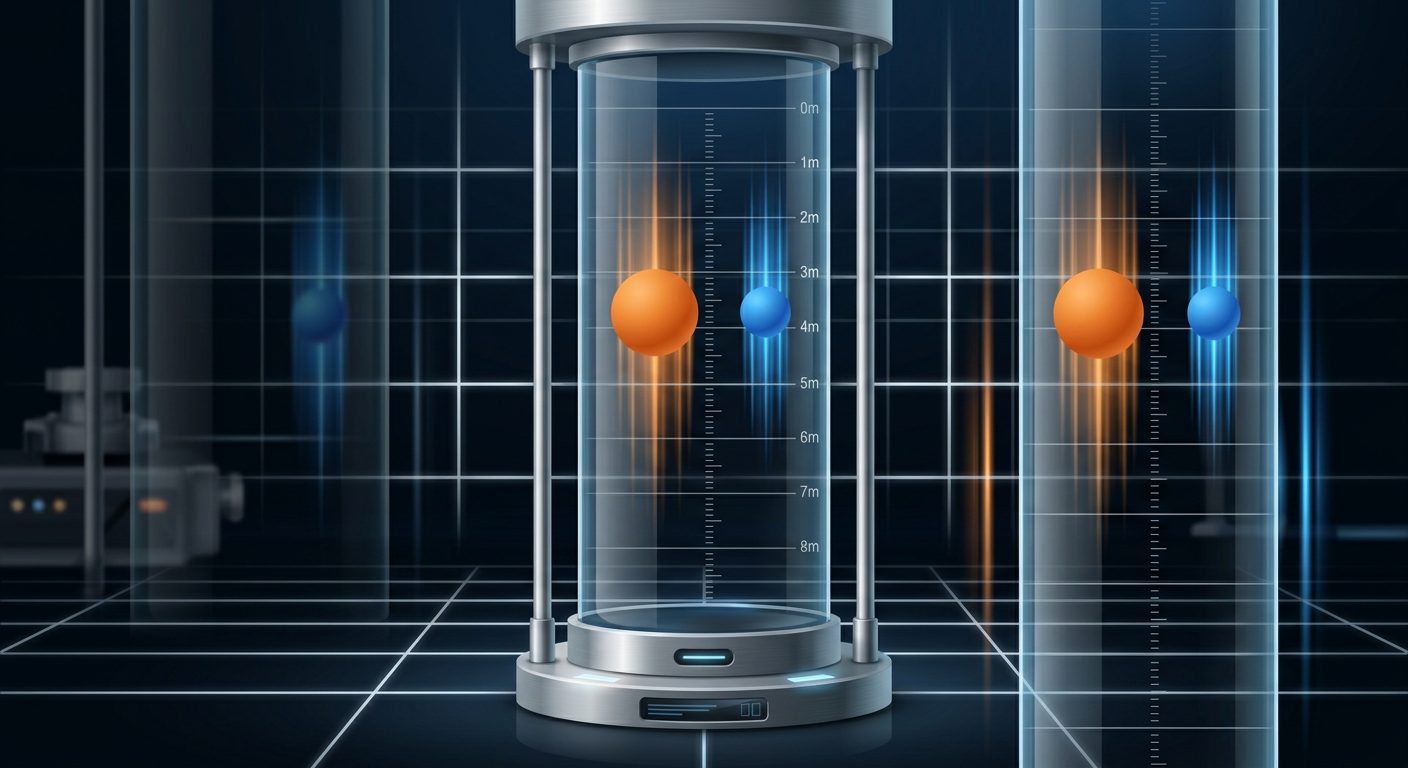
You do not need an Apollo spacecraft to test this yourself. You can try dropping objects on Earth and on the Moon side by side in the Visiora interactive lab! By adjusting the drop height slider from 1 meter to 10 meters, you can observe the motion in slow motion and watch the real-time velocity curves.
Let us look at what the math reveals for a 5-meter drop using the kinematic equation s = ut + ½at² (with initial velocity u = 0):
Time to fall: t = √(2h / g)
Final impact velocity: v = √(2gh)
- On Earth (g = 9.8 m/s², h = 5 m):
- Fall time: t = √(10 / 9.8) ≈ 1.01 seconds
- Impact speed: v = √(2 × 9.8 × 5) ≈ 9.9 m/s (approx. 35.6 km/h)
- On the Moon (g = 1.62 m/s², h = 5 m):
- Fall time: t = √(10 / 1.62) ≈ 2.48 seconds
- Impact speed: v = √(2 × 1.62 × 5) ≈ 4.02 m/s (approx. 14.5 km/h)
On the Moon, a dropped ball takes nearly two and a half times longer to reach the ground, and hits with less than half the speed. Everything feels floaty, relaxed, and cinematic.
Check Your Understanding
- Question: If you drop a 10 kg bowling ball and a 10 g marble on the Moon from the same height, which lands first?
Answer: Both hit the ground at the exact same time. The acceleration due to gravity (g = GM / R²) is independent of the falling object's mass, and there is no air resistance on the Moon. - Question: A spring balance measures 60 N for a package on the Moon. What would an ordinary beam balance read for the same package on Earth?
Answer: A spring balance measures weight (force). On the Moon, W = 60 N, so mass m = W / gm = 60 / 1.62 ≈ 37 kg. A beam balance compares masses by balancing gravitational torques, so it will balance against a 37 kg standard mass on both Earth and the Moon. - Question: Why does the Moon have such low gravity compared to Earth even though it is made of dense rock?
Answer: Earth's mass is about 81 times larger than the Moon's mass. Although the Moon has a smaller radius (which tends to increase surface gravity), its much smaller mass dominates, making its surface gravity only 1/6th of Earth's.
Solved Practice Problems (CBSE Exam Pattern)
Let us work through two standard numerical problems based on NCERT Class 9 Science — Gravitation to solidify your exam preparation.
Problem 1: Mass and Weight on the Moon Class 9
Question: An astronaut with all equipment has a mass of 90 kg on Earth.
(a) What is their mass on the Moon?
(b) What is their weight on Earth? (Take ge = 9.8 m/s²)
(c) What is their weight on the Moon? (Take gm = 1.62 m/s²)
Solution:
(a) Mass on the Moon:
Mass is an intrinsic property of matter and does not depend on location or gravity.
Therefore, Mass on the Moon = 90 kg.
(b) Weight on Earth:
We = m × ge
We = 90 kg × 9.8 m/s² = 882 N.
(c) Weight on the Moon:
Wm = m × gm
Wm = 90 kg × 1.62 m/s² = 145.8 N.
Notice that while the astronaut's mass stays 90 kg everywhere, their weight drops from 882 N to just 145.8 N!
Problem 2: Kinematics Under Lunar Gravity
Question: A cricket ball is thrown vertically upward from the surface of the Moon with an initial velocity of 8.1 m/s. Find:
(a) The maximum height reached by the ball.
(b) The total time taken by the ball to return to the surface.
(Take gm = 1.62 m/s²)
Solution:
Given data:
Initial velocity (u) = 8.1 m/s
Final velocity at maximum height (v) = 0 m/s
Acceleration (a) = -gm = -1.62 m/s² (acting downward)
(a) To find maximum height (s):
Using the third equation of motion: v² = u² + 2as
0² = (8.1)² + 2(-1.62)(s)
0 = 65.61 - 3.24s
3.24s = 65.61
s = 65.61 / 3.24 = 20.25 meters.
Comparison note: On Earth, throwing a ball upward at 8.1 m/s would reach only about 3.35 meters!
(b) To find total time of flight (T):
First find time to reach maximum height (t) using v = u + at:
0 = 8.1 - 1.62t
1.62t = 8.1
t = 8.1 / 1.62 = 5 seconds.
Because time of ascent equals time of descent in free fall:
Total time of flight T = 2 × t = 2 × 5 s = 10 seconds.
Common Pitfalls to Avoid in Exams
- Confusing Big G and Small g: Remember that capital G is the Universal Gravitational Constant (6.67 × 10⁻¹¹ N·m²/kg²), which is the same everywhere in the universe. Small g is the local acceleration due to gravity, which changes depending on the planet or moon.
- Mixing up Kilometers and Meters: Planetary radii are usually given in kilometers (e.g., Moon's radius = 1,740 km). Always convert kilometers to meters (1.74 × 10⁶ m) before squaring in the formula g = GM / R².
- Writing Weight in Kilograms: Weight is a force, so always write its unit as Newtons (N). Mass is measured in kilograms (kg). Writing "weight = 60 kg" will cost you marks in physics exams!
Summary & Quick Reference Sheet
Here is a handy revision summary for your notebook:
- Formula for g: g = GM / R²
- Value of g on Earth: ge ≈ 9.8 m/s²
- Value of g on Moon: gm ≈ 1.62 m/s² (or 1.63 m/s²)
- Ratio of gravity: gm ≈ (1/6) × ge
- Weight relationship: Wmoon = (1/6) × Wearth
- Mass behavior: Constant everywhere (invariant scalar)
- Free fall principle: All objects fall at the same acceleration regardless of mass when air resistance is zero.
Frequently Asked Questions (FAQs)
What is the value of acceleration due to gravity on the Moon?
The acceleration due to gravity on the Moon is approximately 1.62 m/s² (often rounded to 1.63 m/s² in school textbooks). This is roughly one-sixth (16.5%) of Earth's gravitational acceleration of 9.8 m/s².
Why is gravity on the Moon 1/6th that of Earth?
Gravity on any celestial body depends on its mass and radius according to g = GM / R². While the Moon's radius is smaller than Earth's (which tends to increase surface gravity), its mass is much smaller—only about 1/81th of Earth's mass. Combining these two factors in the formula yields a surface gravity that is roughly 1/6th of Earth's value.
How do you calculate the acceleration due to gravity on the Moon using mass and radius?
You can calculate it using the formula g = GM / R², where G is 6.67 × 10⁻¹¹ N·m²/kg², M is the Moon's mass (7.36 × 10²² kg), and R is the Moon's radius (1.74 × 10⁶ m). Substituting these figures into the formula gives g ≈ 1.62 m/s².
Does an object's mass change when taken to the Moon?
No, an object's mass never changes when taken to the Moon. Mass is the total amount of matter inside an object and remains constant everywhere in the universe. Only the object's weight changes, reducing to one-sixth of its value on Earth because of the Moon's weaker gravitational field.
Keep reading

Difference Between Speed and Velocity: Class 9 Physics
Master the difference between speed and velocity for CBSE Class 8–10. Includes comparison tables, formulas, real-world examples, and solved problems.
Do heavier objects fall faster? Galileo's free-fall idea, explained
A bowling ball and a basketball dropped from 30 m land almost together. Here is why mass doesn't decide how fast things fall, and when air changes the answer.
What is Free Fall Class 9? Notes, Formula & Examples
Learn what free fall is in Class 9 Physics (NCERT). Explore the definition, acceleration due to gravity (g), formulas, solved numericals, and quick labs.